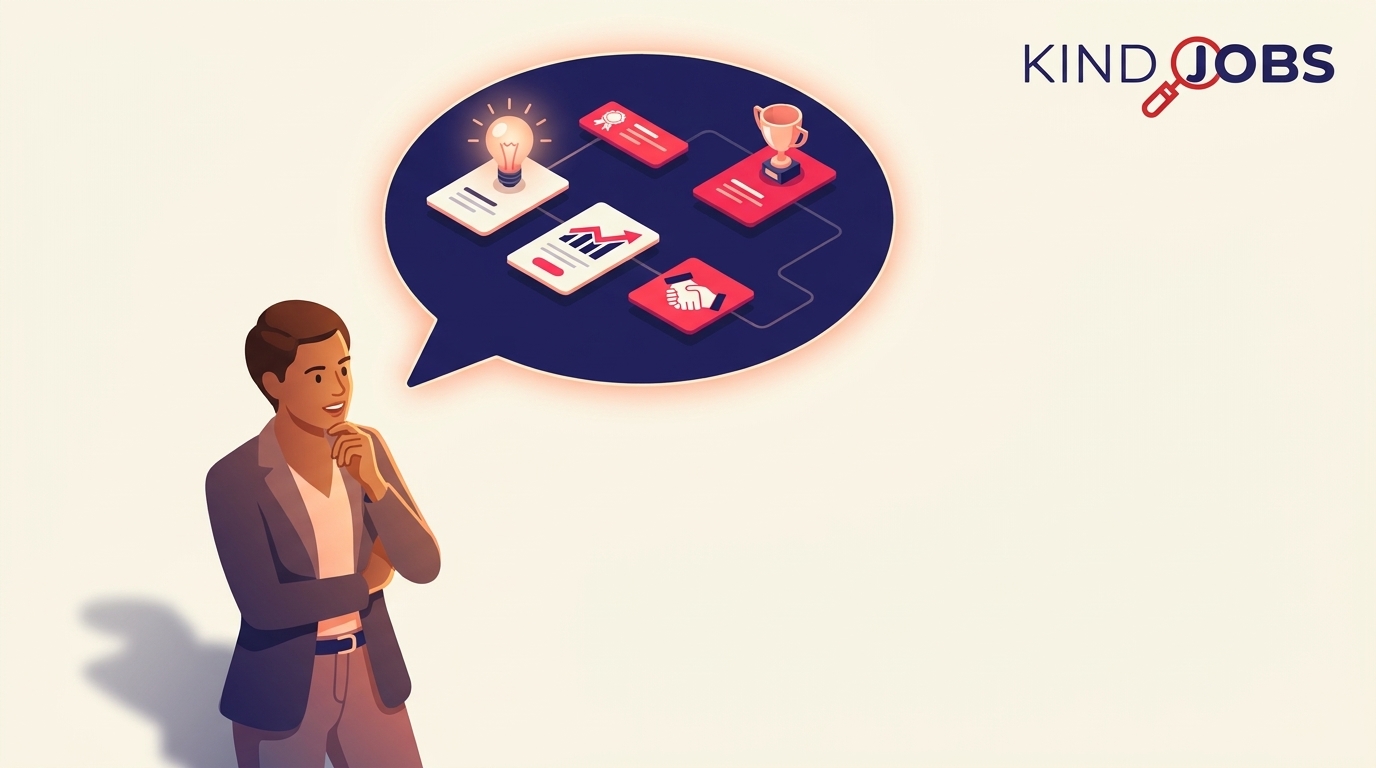
The interviewer leans forward, smiles, and says those five words: “Tell me about yourself.” Your heart rate jumps. Your mind races. Where do you even begin — your childhood, your degree, your last job? This single question trips up thousands of Indian job seekers every year, and yet it is often the very first question in any interview.
Here is the good news: “tell me about yourself” is actually an opportunity in disguise. It lets you set the tone, control the narrative, and make a confident first impression. With the right structure and a little practice, you can answer it smoothly every single time.
Why ‘Tell Me About Yourself’ Trips Up So Many Indian Job Seekers
Most candidates struggle with this question for one simple reason: they treat it like a biography rather than a pitch. They start from childhood, list every college project, and end up speaking for four uncomfortable minutes while the interviewer’s eyes glaze over.
In addition, many Indian job seekers face a cultural challenge. We are often taught to be modest and let our work speak for itself. Talking about your own strengths can feel boastful, so candidates either undersell themselves or fill the silence with unnecessary filler words.
Furthermore, there is a preparation gap. According to a 2026 LinkedIn India Talent Trends report, over 60% of candidates spend less than one hour preparing for common interview questions — and “tell me about yourself” tops that list. That is a costly oversight for a question that shapes every minute that follows.
For example, imagine Priya, a fresh BCA graduate from Pune. She rehearsed her technical skills all week but never practised her opening answer. On interview day, she rambled for three minutes, covering her school results, her parents’ expectations, and two irrelevant internships. She did not get a callback. The content was fine — the structure was not.
A Simple 3-Part Formula to Structure a Confident, Concise Answer
The best way to answer “tell me about yourself” is to use a Past–Present–Future framework. It is short, logical, and easy to remember under pressure.
Past: Start with one or two sentences about your background. Mention your most relevant qualification or your last role. Keep it tight — this is not your life story.
Present: Move directly to what you are doing right now. If you are employed, describe your current responsibilities and a recent win. If you are job-hunting, explain what skills you are building and why you are ready for this new role.
Future: Finish by connecting your goals to the company’s needs. This shows the interviewer that you have done your homework and that you are genuinely interested in this specific opportunity.
In practice, the whole answer should run between 60 and 90 seconds. That is roughly 150 to 200 spoken words. Set a timer when you practise — you will be surprised how much you can say in that window.
Here is a quick example. Ravi, a three-year sales executive from Hyderabad, used this formula: “I completed my MBA in Marketing in 2023 and joined XYZ Telecom, where I grew my territory revenue by 22% last year. Currently, I manage a team of five and focus on B2B client retention. I am now looking for a senior role where I can lead larger teams — which is exactly why your Regional Manager position excites me.” Clean, confident, done.
Meanwhile, if you are actively searching for roles right now, browse verified job listings on Kind Jobs — a platform built for Indian job seekers with zero upfront costs for candidates.
Common Mistakes to Avoid and Quick Practice Drills Before Your Next Interview
Mistakes That Hurt Your First Impression
Starting with “I was born in…” — Nobody needs your origin story. Start with your professional identity instead.
Reciting your resume line by line — The interviewer has already read it. Give them context and energy, not a summary.
Ending without a bridge — Always connect your answer to the role. Without that bridge, your answer feels incomplete.
Speaking in a monotone rush — Nerves speed up your speech. Slow down deliberately. Pause after each part of your answer.
Three Practice Drills You Can Do Today
However, knowing the formula is not enough. You need to build the muscle memory. Try these drills:
The Mirror Drill: Stand in front of a mirror and deliver your answer aloud. Watch your eye contact and facial expressions. Do this five times back to back.
The Voice Note Drill: Record yourself on your phone. Play it back and count your filler words — “umm,” “like,” “so basically.” Each playback will cut them down.
The 60-Second Timer Drill: Set your phone timer for 60 seconds. Begin your answer and stop when it rings. If you finish early, you need more substance. If the timer cuts you off, trim the fat.
Notably, research from Harvard Business Review confirms that structured preparation — not talent alone — is the strongest predictor of interview performance. Practice is not optional; it is your competitive edge. (Source: Harvard Business Review, 2026)
Getting Started: Take Your Prepared Answer Into Real Interviews
Now that you have a formula and your drills in hand, the next step is to find interviews worth preparing for. There is little point perfecting your answer if you are applying to sketchy job postings with no employer accountability.
Therefore, start your search on a platform that vets employers for you. Kind Jobs connects Indian job seekers with trusted, verified employers — completely free for every candidate, with no registration fees or hidden charges.
Create your profile today and start applying to roles that actually match your skills and career goals. Your polished “tell me about yourself” answer deserves a great audience.
Conclusion
The “tell me about yourself” question does not have to be the most stressful moment in your interview — it can be your strongest. Use the Past–Present–Future formula, avoid the common traps, and practise out loud until the words feel natural. Ready to put your answer to the test? Find your next opportunity with verified employers at Kind Jobs — free for every candidate, no upfront costs, ever.